 OMNI
OMNI GEO vs SEO: The Key Differences You Need to Know
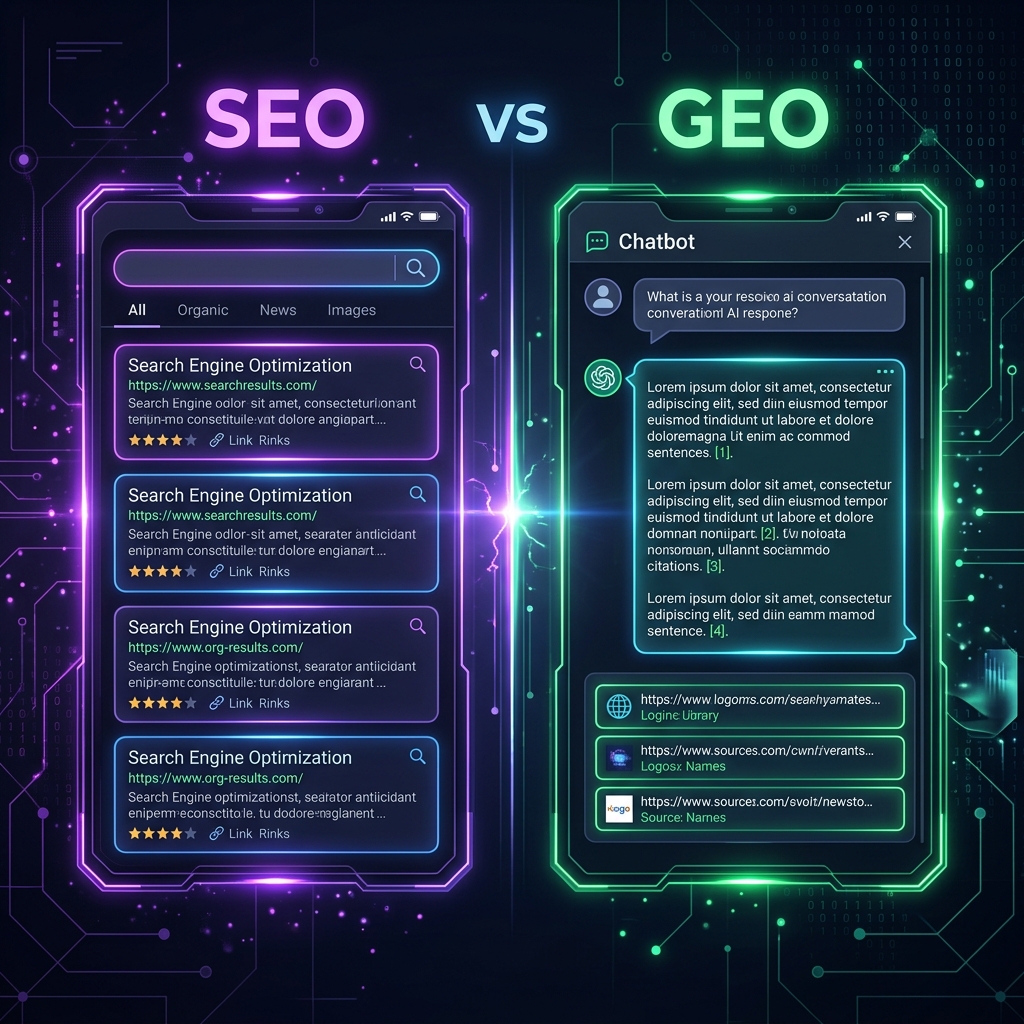
GEO vs SEO: The Key Differences You Need to Know
For the last two decades, Search Engine Optimization (SEO) has been the undisputed king of digital marketing. However, with the rise of Large Language Models (LLMs) and conversational search, a new player has emerged: Generative Engine Optimization (GEO).
In short: Traditional SEO optimizes your pages to rank in search results as blue links, where users must click to read. GEO (Generative Engine Optimization) optimizes your content to be cited as a source directly inside conversational answers generated by AI engines like ChatGPT, Perplexity, and Gemini.
If you don't adjust your content strategy now, your brand risks becoming completely invisible in AI answers.
Understanding the Generative Shift
Traditional SEO is built on keywords, link profiles, and domain authority. Google's goal has always been to display a list of relevant websites that match a search term, forcing users to click through to find answers.
GEO, on the other hand, is built on trust, structured data, and evidence density. AI search engines don't want to redirect users; they want to answer queries immediately in a conversational panel. They synthesize answers from multiple crawled pages and append clickable citations. To get those clicks and drive massive traffic back to your site, your content must be the source that AI engines trust and cite.
To optimize your content structure, tools like Writesonic can help generate well-structured, answer-first paragraphs that AI models love to cite.
The 5 Core Differences: SEO vs GEO
1. Ranking Signals & Access Controls
SEO relies heavily on traditional page speed, URL structures, and backlinks. GEO requires you to actively allow AI crawlers via robots.txt and guide them using structured files. Setting up an llms.txt file for your website is a crucial technical signal that helps AI crawlers parse your core resources efficiently.2. Search Query Intent & Conversational Context
While SEO focuses on specific keyword groups, GEO focuses on answering complex, multi-turn conversational questions. AI engines summarize and synthesize, meaning your content must address questions directly rather than hiding answers behind fluff.3. AI Citation Mechanisms vs. Organic Clicks
In SEO, a top ranking guarantees clicks. In GEO, your click-through traffic depends entirely on clickable citations embedded within the AI answer. If an AI engine uses your data but doesn't cite you, you get zero traffic. To get cited, you must provide high-density facts that the AI can easily reference.4. High Information Density vs. Page Word Counts
SEO content often pads word counts to look authoritative. GEO rewards high information density. Incorporating statistics, statistics-backed facts, and clear data points makes your content highly attractive to AI search synthesis engines.5. Brand Entity Authority vs. Backlink Profiles
SEO measures authority via backlinks. GEO measures authority by looking at your brand's presence across the entire web—social profiles, third-party review directories, and knowledge graphs. Learn more about how these signals work in our comprehensive guide: What is GEO?.How to Optimize for Both Search Eras Simultaneously
It's not an either/or decision. To succeed in the modern web ecosystem, you need an integrated strategy that covers both.
- Write Answer-First: Start every page and section with a direct, 40-word summary of the answer.
- Embed Structured Schema: Add FAQ, Article, and Product schema markup to make parsing easy.
- Optimize with SEO Tools: Excellent content optimized with Surfer SEO satisfies Google's algorithms, while embedding schema and answer-first sections satisfies LLMs.
- Include Clickable Resources: Place clear links, checklist assets, and tools on your site. When AI search engines cite these resources, it triggers a massive influx of highly qualified traffic.
The Complete GEO Checklist 2026
25 actionable steps to optimize your brand for AI search engines like ChatGPT and Perplexity.
Frequently Asked Questions
Q: What is the main difference between GEO and SEO?
A: SEO optimizes your pages to rank in search results as blue links, where users must click to read. GEO (Generative Engine Optimization) optimizes your content to be cited as a source directly inside conversational answers generated by AI engines like ChatGPT, Perplexity, and Gemini.
Q: Does GEO replace traditional SEO?
A: No, they are complementary. SEO drives clicks through traditional search results, while GEO drives visibility and trust through AI citations. An effective modern digital strategy integrates both.
Q: What is the click-through rate of AI search citations?
A: AI search traffic is highly qualified. While many informational queries end without a click, traffic originating from AI search citations has a 14.2% conversion rate, which is nearly 5 times higher than traditional organic search traffic.
Q: How do AI engines select websites to cite?
A: AI engines prioritize sources based on relevance, factual accuracy, schema markup metadata, presence of statistics, and overall brand authority. Structuring content in Self-Contained Units (SCUs) makes it easier for AI to extract and cite.
Q: Can I use SEO tools like Surfer SEO for GEO?
A: Yes. Traditional SEO tools help optimize readability and keyword relevance, which AI engines still value. However, you must supplement them with GEO techniques like adding schema markup, creating an llms.txt file, and writing in an answer-first format.
Check Your Site's AI Search Visibility Now
LLMs index sites differently than Google. Run a free GEO scan to see if ChatGPT, Perplexity, and Gemini can find your business.
You Might Also Like
 OmniRank Media
How to Write an llms.txt File for Your Website
A complete step-by-step guide to setting up an llms.txt file to guide AI web crawlers and ensure accurate citations.
 OmniRank Media
What is Generative Engine Optimization (GEO)?
Learn what Generative Engine Optimization (GEO) is, why it matters in 2026, and how to optimize your brand for AI search engines like ChatGPT, Perplexity, and Gemini.
Get Weekly GEO Strategy Updates
We send practical, technical tips on ranking in ChatGPT, Perplexity, Gemini, and Claude.